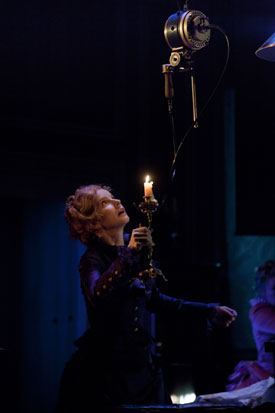
 Left - Jacqueline McKenzie. Cover - Jacqueline McKenzie and Helen Thomson. Photos - Brett Boardman
Nominated in 2010 for three Tony Awards, and nominated for a Pulitzer Prize, Sarah Ruhl’s provocatively titled In the Next Room or the Vibrator Play is sure to be a runaway success for the Sydney Theatre Company. This is my prediction: women will empty the CBD’s offices in droves, head straight to the Drama Theatre at The Sydney Opera House for what will be seen as a high end girls night out, indulging in pricey sparkling wine, a sneaky chuckle and watching the magnificent Jacqueline McKenzie twinkle in the spotlight.
It is the dawn of a new era – Thomas Edison has provided the world with electricity, illuminating parlours across the world. The rosy, flickering glow of candlelight is phased out in favour of a quick flick of a switch. And the benefits of this bourgeoning technology is not going unnoticed or unutilized by medical practitioners, including Dr Givings (David Roberts). Dr Giving’s is a good doctor, so his wife Catherine (Jacqueline McKenzie) is so often told. Aided by his nurse, Annie (Mandy McElhinney), Dr Givings provides relief for those suffering from hysteria – a common “women’s condition” which has symptoms such as faintness, nervousness, insomnia, fluid retention, heaviness in abdomen, muscle spasm, shortness of breath, irritability, loss of appetite for food or sex and in one journal it was said "a tendency to cause trouble" – by firing up The Chattanooga Vibrator.
Catherine waits as her husband administers treatment to Sabrina Daldry (Helen Thomson) who has been brought in by her concerned husband (Marshall Napier) for treatment. Before too long, Sabrina is feeling sprightlier, perhaps even more robust, as a result of the treatment. Meanwhile, Catherine confronts her inadequacies as a mother when Dr Givings agrees to hire a wet nurse Elizabeth (Sara Zwangobani) to nourish their new baby.
After interval we meet the deeply troubled painter, Leo Irving (Josh McConville) who is, though a man, according to Dr Givings suffering symptoms of hysteria. He is after all an artist. Irving too begins to feel the benefits of Dr Givings treatments – inspired to paint once more and he becomes close friends to Catherine in the process.
On a tri-fold card (procured from a less lucrative venue) quotes from In the Next Room or the Vibrator Play’s reception in the United States claim “If Henrik Ibsen and Oscar Wilde had decided to collaborate on a post modern drawing room comedy, the hotsy totsy twosome surely would have turned out something very much like Sarah Ruhl’s genuinely hysterical new work.” Unfortunately this is not so for me, considering the awe I have for Wilde’s wit and his penchant for structure and Ibsen’s complex characters – the comparison is only skin deep – or perhaps costume deep. Particularly difficult is the character of Elizabeth – written as a portrait of the era’s perspective on “Black women” – earthy, indelibly linked with nature and is little more than an overly earnest sketch of Dryden’s noble savage. Act one is a laboured joke about the desperateness of housewives, and upon walking out at interval, I was left wondering what the question of the play was. The second act was seemingly quite a different play in genre and contained more questions which could have been introduced earlier in act one to trigger empathy with the characters.
Director Pamela Rabe, has indulged the comedy in this play in keeping with the mode of drawing room farce, keeping an even pace to the action and allowing the actors room to relish the audience response. However, the deep tragedy from which comedy is born is not fully felt – the sadness that perhaps not much has changed for women. The tragedy of unrequited love is glossed over, and the resolution of the questions of the play: what does it mean to love, physically and emotionally? what is the value of a physical expression of connection? what is it to be a woman, beyond the duty of being a woman? are largely swept up in a climax which seems like a swift left turn in tone and intent for the play. There are deeper issues in this play and Rabe acknowledges this in the Sydney Morning Herald article on the play, but this is not fully realized in production.
Designer Tracy Grant Lord’s set is lavish – but awkward – and thematic design ideas seem to overwhelm the practical reality of the idea of the world of science/men/orgasms etc being firmly “locked away” from women. Despite this, the costuming is spectacular – and each time the costumes are taken on and off we are reminded of the absurdity and transience of women’s fashion.
My prediction continues - that despite my misgivings about the shortcomings of the writing, that audiences will delight at the taboo subject matter of female pleasure and desire, they will celebrate women being put front and centre on Sydney stages, and marvel at the magical performances of such an accomplished cast.
In the Next Room or the vibrator play
by Sarah Ruhl
Director Pamela Rabe
Venue: Drama Theatre, Sydney Opera House
Dates: 7 February - 27 March 2011
Tickets: $35 - $90 (transaction fees may apply)
Boookings: (02) 9250 1777 | sydneytheatre.com.au